


Advertisement
Google researchers have introduced a novel framework for AI research agents that surpasses top systems from competitors like OpenAI and Perplexity in key performance benchmarks.
This innovative agent, named Test-Time Diffusion Deep Researcher (TTD-DR), draws inspiration from the human process of writing, which involves drafting, information seeking, and iterative revisions.
Utilizing diffusion mechanisms and evolutionary algorithms, the system delivers more thorough and precise research on complex subjects.
For businesses, this framework has the potential to fuel a new era of tailored research assistants for high-value tasks that conventional retrieval augmented generation (RAG) systems find challenging, such as creating competitive analyses or market entry reports.
AI Scaling Reaches Its Limits
Energy limitations, escalating token costs, and inference delays are reshaping enterprise AI. Join our exclusive salon to learn how leading teams are:
Converting energy constraints into strategic advantages
Engineering efficient inference for real throughput improvements
Realizing competitive ROI with sustainable AI systems
Reserve your place to stay ahead: https://bit.ly/4mwGngO
As highlighted by the paper’s authors, these real-world business applications were the main focus for the system.
The constraints of current deep research agents
Deep research (DR) agents are crafted to address complex inquiries that surpass basic search capabilities. They employ large language models (LLMs) for planning, utilize tools like web search to gather data, and synthesize these findings into comprehensive reports using test-time scaling techniques such as chain-of-thought (CoT), best-of-N sampling, and Monte-Carlo Tree Search.
However, numerous systems face inherent design challenges. Most publicly accessible DR agents implement test-time algorithms and tools without a framework that mimics human cognitive patterns. Open-source agents often adhere to a rigid linear or parallel process of planning, searching, and generating content, hindering the interaction and correction between different research phases.
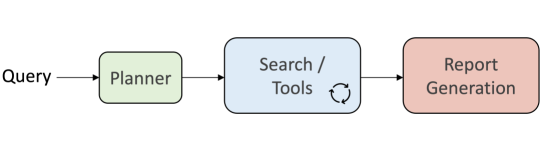
Example of linear research agent Source: arXiv
This can lead to the agent losing the overall context of the research and overlooking critical links between various pieces of information.
As noted by the paper’s authors, “This highlights a fundamental limitation in current DR agent design and underscores the necessity for a more cohesive, purpose-built framework for DR agents that matches or exceeds human research capabilities.”
A novel approach inspired by human writing and diffusion
Unlike the linear methods of most AI agents, human researchers operate iteratively. Typically, they begin with a high-level plan, create an initial draft, and then undergo multiple revision cycles. During these revisions, they seek new information to bolster their arguments and address any gaps.
Google’s researchers noted that this human methodology could be simulated using a diffusion model enhanced with a retrieval component. (Diffusion models, often used in image generation, start with a noisy image and refine it into a detailed image.)
As explained by the researchers, “In this analogy, a trained diffusion model initially generates a noisy draft, and the denoising module, supported by retrieval tools, refines this draft into higher-quality (or higher-resolution) outputs.”
TTD-DR is constructed on this framework. The framework considers the creation of a research report as a diffusion process, where an initial, “noisy” draft is incrementally refined into a polished final report.
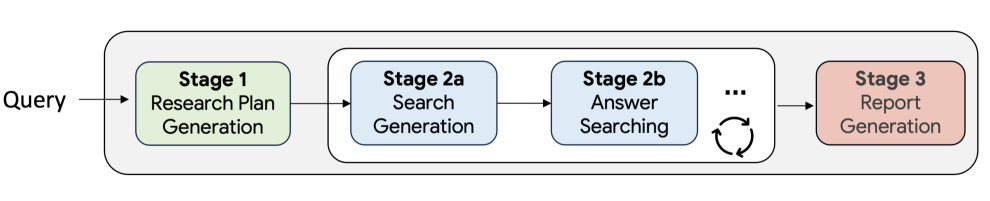
TTD-DR uses an iterative approach to refine its initial research plan Source: arXiv
This is accomplished through two main mechanisms. The first, termed “Denoising with Retrieval” by the researchers, begins with a preliminary draft and iteratively enhances it. In each step, the agent uses the current draft to create new search queries, retrieves external information, and integrates it to “denoise” the report by correcting inaccuracies and adding details.
The second mechanism, “Self-Evolution,” ensures that each component of the agent (the planner, the question generator, and the answer synthesizer) independently optimizes its performance. Rujun Han, a research scientist at Google and co-author of the paper, explained to VentureBeat that this component-level evolution is vital because it enhances the “report denoising process.” This is similar to an evolutionary process where each part of the system becomes increasingly proficient at its specific task, offering higher-quality context for the primary revision process.
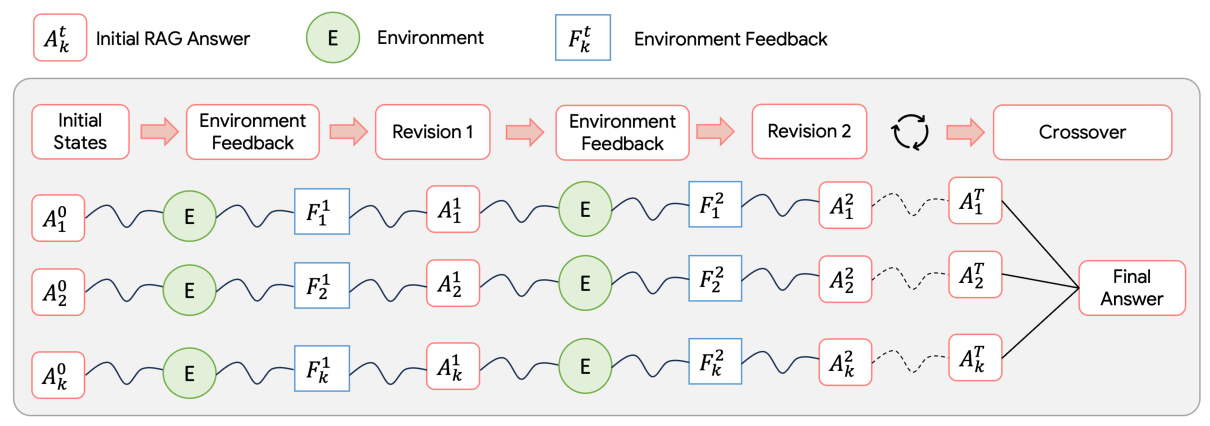
Each of the components in TTD-DR use evolutionary algorithms to sample and refine multiple responses in parallel and finally combine them to create a final answer Source: arXiv
“The intricate interplay and synergistic combination of these two algorithms are crucial for achieving high-quality research outcomes,” the authors state. This iterative process leads to reports that are not only more accurate but also more logically coherent. As Han notes, since the model was evaluated based on helpfulness, which includes fluency and coherence, the performance gains directly reflect its ability to produce well-structured business documents.
According to the paper, the resulting research companion is “capable of generating helpful and comprehensive reports for complex research questions across diverse industry domains, including finance, biomedical, recreation, and technology,” placing it alongside deep research products from OpenAI, Perplexity, and Grok.
TTD-DR in action
To develop and evaluate their framework, the researchers utilized Google’s Agent Development Kit (ADK), a versatile platform for orchestrating complex AI workflows, with Gemini 2.5 Pro as the core LLM (though other models can be substituted).
They assessed TTD-DR against leading commercial and open-source systems, including OpenAI Deep Research, Perplexity Deep Research, Grok DeepSearch, and the open-source GPT-Researcher.
The evaluation focused on two primary areas. For generating long-form comprehensive reports, they used the DeepConsult benchmark, a collection of business and consulting-related prompts, alongside their own LongForm Research dataset. For answering multi-hop questions that necessitate extensive search and reasoning, they tested the agent on challenging academic and real-world benchmarks like Humanity’s Last Exam (HLE) and GAIA.
The results demonstrated that TTD-DR consistently outperformed its rivals. In side-by-side comparisons with OpenAI Deep Research for long-form report generation, TTD-DR achieved win rates of 69.1% and 74.5% across two different datasets. It also outshone OpenAI’s system on three separate benchmarks requiring multi-hop reasoning to find concise answers, with performance improvements of 4.8%, 7.7%, and 1.7%.
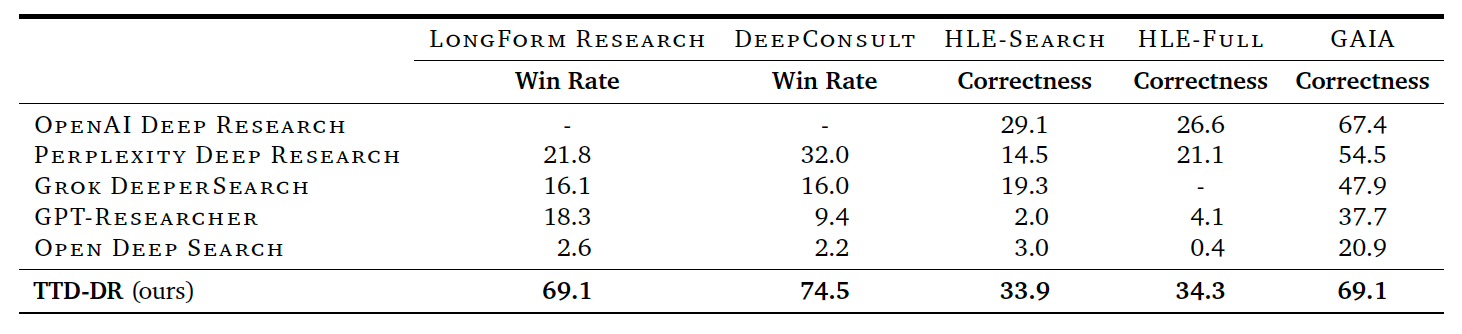
TTD-DR outperforms other deep research agents on key benchmarks Source: arXiv
The future of test-time diffusion
While the current research emphasizes text-based reports using web searches, the framework is designed to be highly adaptable. Han confirmed that the team intends to expand the work to include more tools for complex enterprise tasks.
A similar “test-time diffusion” process could be employed to generate complex software code, develop a detailed financial model, or design a multi-stage marketing campaign, where an initial “draft” of the project is iteratively refined with new information and feedback from various specialized tools.
“All of these tools can be naturally incorporated into our framework,” Han stated, suggesting that this draft-centric approach could become a foundational architecture for a wide range of complex, multi-step AI agents.
Advertisement
Hot News
Advertisement


